
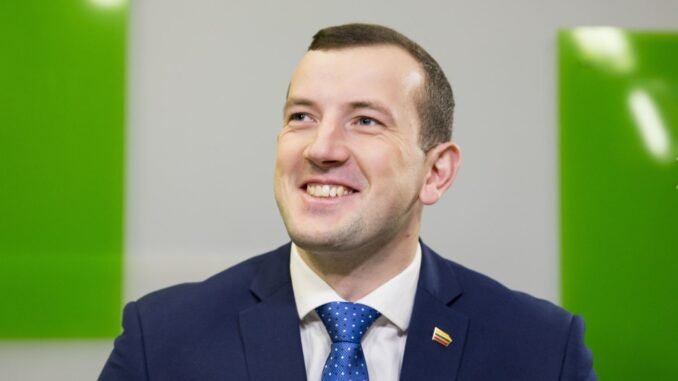
55 questions in 26 minutes – this is the pace at which MEP Virginijus Sinkevičius, who became the interim chairman of the Democratic Union Vardan Lietuvos a few days ago, is now forced to communicate with journalists, Agnė Černiauskaitė states in lrytas article.
Although he insists that the decision in February to express 100% confidence in Saulius Skvernelis was not a mistake, he does not give a direct answer to the question of whether he had any doubts that Skvernelis might not have told his colleagues the whole truth.
“This is a shocking event. You go over countless scenarios in your mind. All kinds of scenarios. From the darkest to the best. I had a lot of different thoughts. But I don’t think there’s a need to share those thoughts. We have to assess the factual circumstances,” Sinkevičius said in an interview with Lrytas.
“The situation is quite serious. Both because it involves Skvernelis and because of the widespread disappointment with politics. All of us politicians bear the common cross of trust in politics. The political system as a whole has suffered a very severe blow,” he acknowledged.
The interim leader of the Democrats makes no secret of the fact that he is actively communicating with President Gitanas Nausėda’s inner circle and another interim Sinkevičius—Social Democratic leader, Mindaugas Sinkevičius. Incidentally, the two spoke today as well. They say it was about prices and inflation. Does he sense Sinkevičius desire to continue communicating and to change the coalition?
“To talk to me—yes; to change the coalition—I don’t know. The Social Democrats are masters of their own fate. If they wanted to change the coalition, they could do so. But so far, that hasn’t happened. I assume that means everyone is satisfied with the way things are,” Sinkevičius reflected.
– Virginijus, I imagine you once hoped to become party chairman, but not under these circumstances. How did those first three days go?
– Very intensely, but the situation demands action. It’s clear that the circumstances aren’t the most pleasant, but at the same time, there are no changes in the party or the faction—the same people whom Lithuanian voters cast their ballots for are still there. The same level of competence. I believe it is very important for the party to show its true colours. After all, the party has absolutely nothing to do with what is happening.
– Well, how can you say there are no changes in the faction, since Jeglinskas announced today that he is stepping down from the Seimas?
– Giedrimas had been considering leaving for some time. His professional horizons were much broader from the very beginning. I think we’ll have a very good addition. Professor Targamadzė is an expert in her field—education. She’ll be a very good addition.
– What reasons did Jeglinskas give you for his departure? And when did you learn of his plans?
– I found out a little earlier, but those considerations had been there from the very first days after Giedrimas was elected to the Seimas. He had to give up many of his activities, his expert work. I am truly grateful to him for the years he spent as chairman of the National Security and Defence Committee—his dedication and the time he devoted to Lithuania’s defence architecture are truly significant. I am glad that he remains a member of the party. He will continue to contribute to our party’s defence proposals actively.
– So, this decision has absolutely nothing to do with the circumstances that are currently…
– No, absolutely nothing to do with it. It is related to Giedrius’s own professional activities. As I said, he remains a party member; he is leaving the Seimas.
– In February, following the searches at Skvernelis residence, your party’s board met to decide what to do next, whether he should step down from the party leadership. Hoping this would happen, I sent you a message before the board meeting, saying I would be the first in line to speak with you as the new leader of the Democrats. Do you remember what you replied?
– That I would have to wait a few more years.
– Yes. Can we assume that you were reassured by Skvernelis’s word that he had done nothing criminal?
– Yes.
– So how did you take Thursday’s news?
– Obviously, that news is unpleasant. From the very beginning, this story has been unpleasant, especially when the word “bribe” is mentioned alongside a politician’s name. I’ve said this before—it’s a deadly weapon for a politician’s career. Especially for a politician like Skvernelis. But justice in Lithuania is administered by the courts. We’ll see.
The Prosecutor’s Office and the Prosecutor General see a need to request the lifting of immunity. We have always maintained that no politician, not even the former chairperson of our party, can hide behind the immunity of a Seimas member. Skvernelis himself affirms this. He will have every opportunity to defend himself in court.
– Your colleagues, with whom I spoke that day in the Seimas, didn’t seem as shocked as they were in February, right after the searches; they joked that they’d already gotten used to the idea of what might lie ahead.
– I don’t know; to me, there’s little to be cheerful about in such a situation. The situation is serious enough. Both because it involves Skvernelis and because of the widespread disappointment in politics. All of us politicians bear the shared burden of eroding public trust in politics. The political system as a whole has suffered a massive blow.
– “There were different expectations based on what Skvernelis said.” That’s what you said on Thursday. Does that mean Skvernelis didn’t necessarily tell you the truth?
– It’s not for me to judge. We must, after all, evaluate the factual circumstances and the evidence gathered by the STT and the prosecutor’s office—what that evidence will be and what will be presented. I understand that, as of today, all of this is based on witness testimony, not concrete evidence. As I said, I am no prophet. I can only rely on the available information.
When we decided to support Skvernelis, we relied not only on Skvernelis’s word but also on the public statement from the Prosecutor General’s Office. It stated that the actions taken were not related to politicians and that no suspicions or charges were brought while the circumstances were being clarified. We always make decisions based not on emotions, but on the information available at the time.
– Please elaborate on how he explained to you, even before Thursday, what happened here.
– Exactly what he said and continues to say publicly. The relationship (with Silickienė – Lrytas) over the past nine months was strictly professional; they may have known each other before that, but Skvernelis himself had nothing to do with the Plant Protection Service. It is clear that he did not register any draft laws and never sought any patronage for that service. After all, that service did not start operating this year. It was active during the previous government as well, and judging by the stories emerging, it’s clear this corruption scheme has been operating for a very long time. It was only recently shut down.
– Didn’t you have even the slightest doubt that the party leader might not be telling you everything?
– I can only speak for myself; I cannot speak for other people. What other people say, what the prosecutor’s office says, I have the opportunity to hear and assess. But by no means am I a prophet or a lie detector who knows who is telling the truth and who is not.
– At the time, you expressed complete trust in Skvernelis’s word…
– That was the community’s decision. The community, as I said, relied on the available facts, including the communication from the Prosecutor General’s Office.
– So, if I ask whether you didn’t have even the slightest doubt, I understand that you didn’t?
– (Silence). This is a shocking event. You run through countless scenarios in your mind. All kinds of scenarios. From the darkest to the best. I had a lot of different thoughts. But I don’t think there’s a need to share those thoughts. We have to assess the factual circumstances.
– You met with Malinauskas on Sunday. Whose idea was it?
– Skirmantas and I have known each other for a very long time. We meet fairly regularly, whenever the opportunity arises. I don’t know whose idea it was—maybe mine, maybe his; it’s hard to say.
– It’s only been a day, so maybe you remember who suggested it?
– It’s not some extraordinary event. I have coffee with a lot of people in town…
– Lately, he’s been talking a lot about various details that we haven’t even heard from law enforcement yet. Did you meet to discuss what he’s been saying?
– No. Anyone who knows Malinauskas knows that it’s impossible to edit or influence what he says.
– So, what did you talk about?
– A wide range of topics. Of course, this topic as well. We’ve been in contact for many years, so we have a lot of topics we can discuss.
– Did you also discuss the information he spread about alleged backroom deals between Skvernelis and Paluckas regarding how to preserve a member of the Seimas’ immunity? How accurate might this information be?
– We didn’t talk about it. I immediately sent him a message saying he had been misled, since no such conversations had taken place. We certainly didn’t go into detail, and I never ask Skirmantas who his source is or anything like that.
– Why doesn’t Skvernelis himself resign his parliamentary seat? Doesn’t this make him the very millstone around the party’s neck that he promised not to be?
– Skvernelis is no longer a party member. The voters granted his seat, and the decision on whether it is extended or not is made through elections. In this case, I believe the choice is primarily because Skvernelis is not afraid of public scrutiny. Of course, if he were to give up his seat, it might even be easier, because you would become a private citizen and your data would not be disclosed.
Here, journalists had to dig around and learn from rumours that charges had been filed against Starkevičius (The Prosecutor General’s Office has not confirmed this information – Lrytas). In this case, it seems to me that Skvernelis is not afraid of that publicity.
– On Thursday, he issued an initial comment, but on Friday, he stopped speaking and left for Poland. Do you know what business he had there?
– I know. It was a trip planned long ago. The Seimas Board was also informed. It has absolutely nothing to do with this case. It’s related to other circumstances.
– So, it’s a personal trip?
– Yes.
– Skvernelis has decided to remain in the Seimas, but, as I understand it, he’ll be leaving the faction?
– That’s his choice.
– Has he already informed you that he will be leaving?
– I believe the faction will meet tomorrow, Saulius, and I hope he will announce his decision one way or another. (Later on, Monday, Skvernelis announced that he would be leaving the Vardan Lietuvos Democratic faction and joining the Mixed Parliamentary Group, but reportedly made the decision not of his own volition, but following a comment by Sinkevičius – Lrytas). As far as I know, Skvernelis will not ask for a commission to be formed; he will urge Seimas members to vote to lift his immunity so that the process can move forward as quickly as possible.
– Do you support his decision to remain in the Seimas?
– That is his personal choice. The fact that he isn’t running away or hiding sends a very clear signal.
– As we’ve already discussed, Jeglinskas will be replaced in parliament by Targamadzė. That means Skvernelis, if he does decide to step down, would have to be replaced by Bakas. How ironic…
– That has absolutely nothing to do with it. Absolutely nothing. Jeglinskas’ final decision—not just some musings—was made known at the end of the week. I can assure you that this has absolutely nothing to do with it.
– In any case, the faction will lose one member—if Skvernelis stays, he’ll join the Mixed Group; if he leaves and Bakas comes in…
– I don’t know which faction Bakas would join.
– He doesn’t even belong to your party anymore.
– So what? We have members in our faction who don’t belong to the party. That would be Vytautas’s choice.
– And do you keep in touch with him?
– We had some contact, let’s say, when this scandal broke out. But we are by no means enemies. I really don’t know how Vytautas would act, or if he would come to the Seimas, because he has completely withdrawn from political activity and returned to his professional work. I can’t imagine how he would act.
– So, maybe when Skvernelis suspends his membership, will Bakas return?
– The party’s doors are wide open to everyone. Anyone who wants to come and join—we truly invite them to build a strong community. Likewise, anyone who doesn’t see the point in staying can leave.
– Have any others announced their intention to leave the party in recent days?
– No. Let me reiterate that Giedrimas has not left the party; he remains a party member.
– Political analysts say your party missed the opportunity to distance itself from Skvernelis in time, and now it will be extremely difficult to do so. Let me ask you straight out—was the decision to express full confidence in the party leader a mistake?
– No, I don’t think it was a mistake. I’ll say it again: we need to take into account the sentiments of the community that supported Skvernelis. For some people, of course, what happened came as a shock, but the key point was still that it wasn’t clear what was actually going on here.
Now people are trying to compare this to the Masiulis case… These are completely unrelated matters, because in Masiulis’s case, the cash was found immediately and marked. Now, neither a transfer of money has been recorded nor has any money been found. Starkevičius role in the Conservative Party is incomparably smaller than Skvernelis’s in the Democrats. In this case, I believe that decision was not a mistake.
– Lithuania now has two interim party leaders, Sinkevičius. One will soon seek to shed the “interim” label and become the permanent chairman. What will you do?
– We will have a party convention in July. Until July, party chapters will have the opportunity to nominate candidates for party chairman.
– I’ll venture to predict that you’ll have no choice but to accept the position, and this summer, having earned the party members’ trust, you’ll transition from interim to official party leader. What’s next? In that case, will you return to Lithuania, or follow the path already trodden by Blinkevičiūtė, as now mentioned by Veryga?
– I cannot rule out any scenario. For now, I am the interim chairman, and it is far too early to speculate on what might happen later. Today, the people of Lithuania, the voters, have entrusted me with a seat in the European Parliament, and I represent their interests in the European Union.
– From what I’ve heard, I understand that you and your family have settled into life in Brussels and, at least for now, you’re not particularly eager to return to Lithuania.
– Nevertheless, I am fulfilling the duties of a Member of the European Parliament. It would be strange to return to Lithuania and serve only as party chairman. We have a very strong team here. I don’t see a challenge in that. We see that the chairs of other parties are also very successfully serving as both Members of the European Parliament and party chairs. I really don’t see a major challenge in that.
– Well, perhaps it should also be noted that even after returning here, if you don’t join the coalition and don’t hold a position in the government, you wouldn’t have anything to do, since the position of party chairperson is unpaid.
– Yes, it is an unpaid position. But we are not in the coalition.
– Regarding the coalition. When was the last time you spoke with Sinkevičius?
– I spoke with him recently.
– When?
– I spoke with him fairly recently. I spoke with him this week.
– Today is Monday. So today?
– Today.
– What did you talk about?
– About the fuel crisis.
– Don’t lie.
– Seriously. About the fuel crisis, about prices, about inflation.
– And about the coalition?
– We didn’t talk about the coalition today.
– Have you received any unofficial proposals or presented your own positions on what you’d like?
– No. There are definitely no negotiations taking place yet. (Silence) Well, really…
– It’s hard to believe that two interim Sinkevičius would call each other, with a Social Democratic Council meeting just a few days away, and not discuss what to do or whether it’s possible to work together…
– Our position is clear. It hasn’t changed. It is public and accessible to everyone. I don’t need to meet with Mindaugas or anyone else in secret to state that position. The fate of the coalition is in the hands of the Social Democrats. If they see a need to change the coalition, negotiations must begin. These must be official negotiations, not some casual inquiries in the Seimas about how you feel or whether you’d be interested. If official negotiations were to begin, I could confirm that fact to you. I have known Mindaugas for many years; we have always maintained fairly friendly relations.
– Alright, then I’ll ask it another way. Do you sense a desire from Sinkevičius to change the coalition, to have a serious conversation with you?
– To talk with me—yes; whether to change the coalition—I don’t know. The Social Democrats are masters of their own fate. If they wanted to change the coalition, they could do so. But so far, that hasn’t happened. I assume that means everyone is satisfied with the way things are.
– I’ve also heard about your conversations with President Nausėda. Same question again—when was the last time you spoke with him?
– The last time I spoke with the president was to wish him a happy Easter. Really. Via text message.
– That’s fine, but I’m asking about the coalition.
– I haven’t spoken with the president. Really. I haven’t.
– Since the February raids at Skvernelis’s place?
– No, I haven’t spoken with the president.
– What about the president’s inner circle?
– I have spoken with the president’s inner circle.
– And about the coalition?
– A lot of questions. Including—about the coalition.
– Am I correct in understanding that the president supports changes in the coalition?
– You’ll have to ask the president and his inner circle. I’m not his press secretary.
– But you’ve spoken with them.
– I didn’t speak with the president himself. It seems to me that the president has publicly stated his position, which, in my view, is clear enough. If the coalition cannot agree on critical issues, such as defence, then it is clear that this coalition, to quote the president, is for nothing.
– What is your own position, given the current circumstances and the situation the party itself finds itself in—would it be beneficial for you to join the ruling majority or not?
– This isn’t about us. It’s about Lithuania. The most important thing is what would be best for Lithuania.
Difficult times lie ahead for Lithuania and the Lithuanian people. We see the geopolitical situation, which has a major impact on prices, especially fuel prices, and all of this will likely drive up the cost of goods and services in the long run. This will lead to inflation; the cost of living is likely to rise further, and it is already high enough for the average household. This is a major challenge.
Secondly, I see a major challenge regarding the presidency. Lithuania will have a historic opportunity, and I would like the coalition in power at that time not to be criticised for its work, nor for it to be overshadowed by various scandals or court rulings. The Democrats are and always will be working for Lithuania. Even in opposition, we are the most active. (…)
– So, if joining the coalition is about Lithuania, then the positions won’t matter?
– Positions are always a secondary matter. The work comes first. We see that after we left the coalition, some projects stalled. Those projects are critical. For example, regarding price monitoring, which seems to be coming back now, but implementation had stalled. We certainly have proposals on how to improve the Government’s program to address today’s challenges.
– Virginijus, don’t you think you’re just a pawn for Žemaitaitis? It wouldn’t be the first time.
– If it helps Lithuania and the Social Democrats—I’m not worried about it. Just as the Democrats had their goals while working in the opposition, we still have them. If the Social Democrats see that spreading rumours about negotiation is useful to keep Žemaitaitis in check and to help them achieve the goals defined in the Government’s program, which are beneficial to Lithuania, so be it.
– Last question. What kind of party leader will Sinkevičius be?
– Inevitably, each of us is different. Our styles are probably different from Skvernelis’s.
My main desire is to maximise the effectiveness of the party and its branches. We need not only leadership here at the centre, which is certainly very strong—even though there are attempts to label it a one-person party—but also regional leadership, especially with local elections approaching. For this reason, the activity of our branches and our local leaders will be particularly important.

Be the first to comment