

Lithuania is left without a prime minister – on Thursday, scandal-ridden Prime Minister Gintautas Paluckas finally resigned, Agnė Liubertaitė states in lrytas. Political scientists say that this decision is essentially a good one, albeit belated. It will now be exciting to watch the new coalition’s moves.
What was the last straw?
President Gitanas Nausėda admitted that he received a call from Prime Minister Paluckas on Thursday morning. Paluckas personally informed him that he was stepping down.
“The decision was long overdue, but better late than never. Considering the standards of democratic politics and the expectations of transparency that we should have of politicians, it is a little late on that front,” Ignas Kalpokas, a political scientist at Vytautas Magnus University (VDU), told the Lrytas news portal.
He believes that Paluckas should have thought more seriously about stepping down after the first journalistic investigations, rather than when the scandals surrounding him became practically uncontrollable.
However, it was soon announced that another person, Jonava Mayor Mindaugas Sinkevičius, would also take over the leadership of the Social Democratic Party.
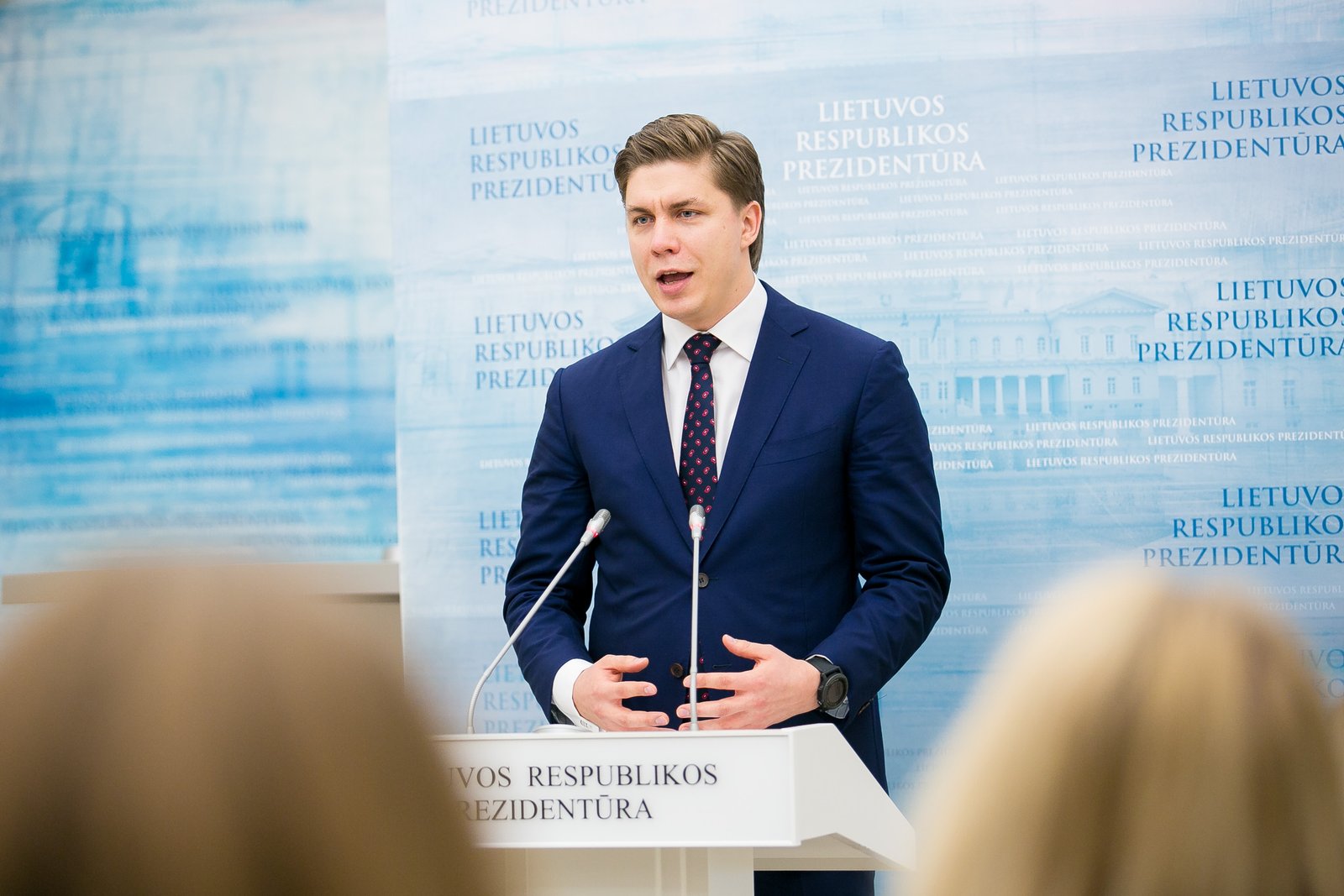
“Sinkevičius was, I believe, the first Deputy Chairman – there was probably some kind of peace agreement between them that Sinkevičius would not throw his hat into the ring for the party chairmanship and would essentially become second in command, so from this point of view, it comes as no surprise.
But in principle, it was probably to be expected that now the race for the top positions, provided there was no prior conspiracy in the chamber, would be between Sinkevičius and Olekas,” said the VDU political scientist.
What might the new coalition look like? According to Kalpokas, there could be some interesting developments here.
“If we recall the ultimatum from Skvernelis, what we have today is only the first part of that ultimatum. The second part was aimed at Nemuno Aušra.
Žemaitaitis himself, in his recent communications, has been very personally oriented towards Paluckas, and it is not guaranteed that Žemaitaitis will remain after Paluckas leaves.

Perhaps some contradictions will emerge among the Social Democrats, because let us remember that Sinkevčius himself was pretty critical of the coalition with Nemuno Aušra,” said Kalpokas.
When asked what could have been the last straw for Paluckas, he suggested that it was probably a combination of several factors.
“One thing is yesterday’s ultimatum from Skvernelis, which greatly weakened the position, despite the attempts of the Social Democratic leadership to shift the blame onto Skvernelis himself, saying that he was overstepping his boundaries,” said Kalpokas.
Another thing, according to the political scientist, is that the ultimatum probably already reflected the mood within the coalition itself.
“The Social Democrats’ single-mandate members certainly couldn’t have been pleased with the situation, and I think they were looking for some alternative centres of power. I think that Skvernelis, either sensing this or perhaps even agreeing with some of the Social Democrats, issued this ultimatum. It was probably the case that internally – both within the party and the Seimas faction – the support was not as monolithic as they were trying to demonstrate,” stated Kalpokas.
According to him, the morning search of the prime minister’s sister’s company also yielded no results.
“If there was still room for that last drop, then that was what it had to be,” Kalpokas said.
The Paluckas scandal taught us a lot
As Mykolas Romeris University political scientist Saulius Spurga wrote on Facebook, the prime minister’s resignation is a rare and very significant event.
“What can we say? After Skvernelis announced that Vardan Lietuvos (In the Name of Lithuania) would withdraw from the coalition if Paluckas remained Prime Minister, the situation changed dramatically, and it became clear that changes were inevitable.
The resignation of the Prime Minister Paluckas is undoubtedly a significant and rare event. Urbonaitė recalled that the last time this happened was in 2006, when Brazauskas resigned. After that, all prime ministers served their full terms. According to the Constitution, when the prime minister resigns, the entire Government resigns. Of course, in such a case, the coalition partners will have to renegotiate.
It is worth recalling Article 84 of the Constitution, specifically Point 8, regarding the President of the Republic. If the Government resigns or returns its powers, the President shall, within 15 days, submit the candidacy of the Prime Minister to the Seimas for consideration and approval. The process will be pretty rapid. All ministers will have to be reappointed and a new Government program will have to be approved,” wrote Spurga.
She claims that Paluckas scandal “revealed a lot and taught us a lot.”
“Paluckas’ resignation was inevitable after Laisvės TV and the investigative journalism centre Siena published an investigation into a EUR 200,000 preferential loan received by the Prime Minister’s company Garnis.
And when was this investigation published? On May 28, 2025, and once it was published, it was clear that the prime minister would be unable to continue his work, as it was obvious that an avalanche had started that would not stop, but only grow.
It took the Social Democrats and other coalition partners two months to understand this – and during that time they demonstrated various dishonourable tricks of evasion, whitewashing, manipulation, and squandered enormous amounts of trust,” wrote Spurga.
However, the political scientist added that this scandal also revealed the true face of President Gitanas Nausėda. And that, he said, was perhaps the biggest disappointment.
“The president not only demonstrated significant bias by tolerating the prime minister’s various violations that had come to light. No less sad is the fact that the president failed the test of political culture and, after a cheap exchange of words with Gentvilas, can hardly be considered a moral authority in the country.
Paluckas also resigned from his position as Chairman of the LSDP. The mayor of Jonava District, Sinkevičius, will temporarily assume these duties.
Given that Sinkevičius is notorious for his involvement in the cheque case (the television case), such a change of chairman seems grotesque,” said Spurga.
According to the political scientist, the fact that Žemaitaitis and Skvernelis disagree could create intrigue in the coalition.
What happened?
Paluckas, who decided to step down as prime minister, insists that he does not believe he made any significant mistakes during his tenure.
“I am human and I must admit that I have made mistakes in my previous activities – I apologise once again to everyone for that. However, as prime minister, I do not feel that I have made any fundamental mistakes or committed any offences – I performed my duties as prime minister honestly, as I understood and was able to,” Paluckas said in a statement.
Over the past couple of months, new journalistic investigations into Paluckas past, business connections, and suspicious transactions have been emerging in the public sphere.
At the end of May, the investigative journalism centre Siena and Laisvės TV reported that Garnis, a company partly owned by the prime minister, had received a preferential loan of EUR 200,000 from the national development bank ILTE while Paluckas was already serving as prime minister.
The second part of the investigation by Siena and Laisvės TV raised questions about the hundreds of thousands of euros in loans that Sagerta, a company that developed a lake bottom topography application managed by the head of Government, received and did not repay before 2018. The head of government had controlled the company Sagerta, which developed a lake bottom topography application, and received and failed to repay hundreds of thousands of euros in loans from Uni Trading, a company linked to businessman Darijus Vilčinskas.
In addition, it was reported that in 2012, the future prime minister purchased a home worth EUR 223,000 in the Verkių Regional Park in the capital from a company headed by the businessman. Although Paluckas denied having any business relations with Vilčinskas, the latter later admitted to Verslo žinios that he had invested in the Social Democrat’s company.
Soon, a third investigation emerged – Siena and Laisvės TV discovered that in 2012, a Cypriot company sold Paluckas a flat in the centre of the capital at a low price on a plot of land that the politician himself had acquired while serving as director of the Vilnius City Municipality Administration.
Finally, on Sunday, it emerged that just a few weeks ago, Paluckas had paid the last EUR 4,900 of the EUR 16,500 in damages awarded to Vilnius City Municipality in the so-called “rat case” in 2012. The politician paid the last EUR 4,900 of the EUR 16,500 awarded to Vilnius City Municipality on July 8 this year.
Journalists from the Redakcija channel also reported on Paluckas’ past. The investigation noted that in 2009, the Social Democratic leader acquired a plot of land on Laurų Street in Vilnius, which, as the court later ruled, was illegally privatised state-owned forest. In addition, the plot was formed for the restoration of property lost by people during the Soviet era, but soon fell into the hands of the prime minister and Genovaitė Arlauskienė.
Finally, public figure Andrius Tapinas reported that Dankora, a company founded just last year by Virginija Paluckienė, the sister-in-law of Prime Minister Paluckas, received European aid, most of which was spent on purchases from Garnis, a company partly owned by the prime minister.
The Financial Crime Investigation Service (FNTT) is conducting a pre-trial investigation into the use of the ILTE loan received by Garnis, and the Supreme Commission for Professional Ethics (VTEK) is also assessing the situation. The Special Investigation Service (STT) is investigating the circumstances of the second investigation.
Meanwhile, the opposition in the Seimas is already collecting signatures to call an extraordinary session, during which it cannot be ruled out that impeachment proceedings against Paluckas may be initiated.

Be the first to comment