
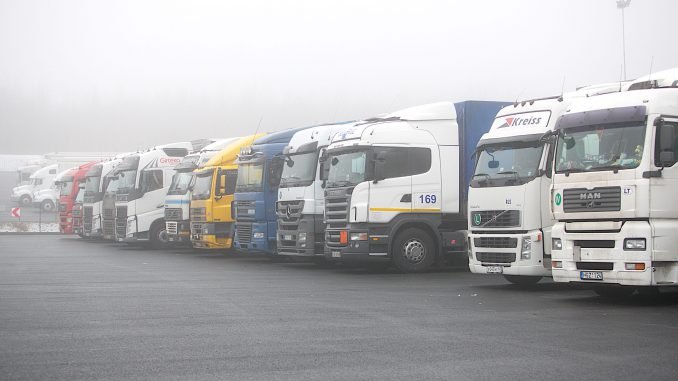
The border with Belarus was opened at midnight on Thursday, but Lithuanian carriers are still not allowed to leave, Aurimas Perednis states on Žinių Radijas programme. According to the leaders of the National Carriers Association LINAVA, Minsk is demanding negotiations with the Ministry of Foreign Affairs. It is indignant at Lithuania’s unilateral decision to close the border, lrytas.lt reported.
At that time, smuggled balloons had once again disrupted operations at Vilnius Airport on 20 November evening, and Lithuanian airports appealed to the prosecutor’s office to launch an investigation into the threat posed by the balloons and to compensate for the damage caused. The situation repeated itself on Sunday.
This situation, caused by the repeated influx of weather balloons and the government’s response to it, could lead to the government’s collapse, said Viktorija Čmilytė-Nielsen, leader of the Liberal Movement, in an interview with Žinių Radijas. She called the situation an absolute fiasco for the government.
On the Žinių Radijas programme “Dienos klausimas” (Question of the Day), Minister of the Interior Vladislav Kondratovič, President of the National Carriers Association LINAVA Erlandas Mikėnas, and Member of Parliament Lukas Savickas discussed the situation and who stands to gain from it.
“The entire legacy that we are now trying to clean up is precisely the legacy of the former liberal government,” said Minister of the Interior Kondratovič in response to Čmilytė-Nielsen’s criticism of the government for allegedly not being able to cope. “Borders, tensions, migrants—their contribution to this issue is very significant. I think that they themselves have not really managed to deal with it in four years. There were some good things, but there were also things that remained unresolved.”
According to the minister, business has always travelled through Belarus as a transit country, so it was possible to anticipate such issues and put safeguards in place to prevent them. But this was not done, and it is now the current government’s task to solve this problem.
Created new problems
Savickas, a member of the Seimas representing the opposition, believes that the government should acknowledge its mistakes.
“The situation is being exacerbated in a place where all that is needed is a simple acknowledgement that the situation is indeed complex and has no clear precedent. There is a lack of recognition that although the intentions and goals were good—to show a strong state position to control the rise of smuggled balloons and their negative consequences for Lithuanian air traffic— the way in which these measures were implemented not only failed to solve the problem but also created new problems,” said Savickas.
One of the new problems is that carriers are becoming hostages. According to the politician, the Seimas Economic Committee raised the question of whether carriers were warned so that their vehicles and drivers could leave Belarusian territory in time, thereby avoiding a hostage situation that the Belarusian regime exploits professionally.
There has been talk of changing diplomatic relations with the Belarusian regime – in Savickas’ opinion, this is yet another problem Lithuania did not have before.
“All this requires recognition that the goals were good, but the implementation was certainly not the best, to put it mildly, and we need to build on this in our search for other necessary solutions to get out of this situation,” said Savickas. Today, Lithuania’s interests are clear: to counter the hybrid threat, ensure free air traffic, recover drivers and vehicles stuck in Belarus as soon as possible, and maintain the continuity of the country’s policy.
They paid for parking, but are not being released
Linava President Mikėnas said that on Friday, all drivers were ready to leave, and their managers paid for their parking: “They transferred the money to Paysera, Paysera withdrew the money from the bank, and paid through the bank. The parking lot at the Belarusian border, where they are parked, reported that the carriers had paid, and we could send them to the border. But the Belarusian border said not to send them because they couldn’t process them.”
According to Mikėnas, the mood is gloomy, and information changes every half hour. “Yesterday, I received information that two trucks had entered, then I received information that local trucks were driving here, and today the Customs Department confirmed that three trucks had entered through Šalčininkai, but it is unclear where they came from,” said the president of Linava. Mikėnas said that he only gets all the information from company managers who go there to pay.
“Based on what I hear from the president, the Belarusians are most likely still following the previously adopted resolution, which does not allow trucks registered in Lithuania to cross the border,” explained the Minister of the Interior. Attempts are being made through diplomatic channels to find out what is preventing the trucks from leaving. “We have provided all the information we have, and notes have been sent from the Ministry of Foreign Affairs. We ask carriers to provide us with any information they may have so that we can make decisions as quickly as possible,” said Kondratovič.
What is Lukashenko aiming for?
“The long-term international policy we have pursued towards both the Russian and Belarusian regimes has been one of isolation from the global arena. It is natural to seek to restore the opportunity to be at the table, to participate in talks, to establish diplomatic relations.
Today, we see that the Lithuanian government, which had good intentions, wanted to create a means of pressure from a position of strength and say that we are responding to your tolerance of smuggled gas cylinders or hybrid warfare against Lithuania.
However, this measure was implemented in such a way that, instead of being a means of pressure, we found ourselves in the position of a supplicant. We had to return to our original position, reopen the borders, and continue looking for ways to get our freight vehicles back. And this is the result of our government’s inability to think a few steps ahead,” said Savickas.
The Belarusian regime took advantage of our government’s oversight, as if it were in a textbook, according to the politician. “Our good intentions have turned into a tactical defeat, and now we have to solve not one, but two problems,” he said.
The Poles are benefiting from the situation
“Knowing the mentality of the aggressors in those countries, we will never be able to corner them,” said Linava President Mikėnas. “We made a mistake by closing the border and shot ourselves in the foot. Carriers are suffering huge losses; they are not receiving income, nor is the state.
It’s very easy to say, ‘Don’t go to those countries. ‘ That means no income, no taxes. If we don’t go, other countries will, and transport flows through Lithuania will be disrupted, even though we have long wanted to be a transit country.
We are first in the EU in terms of transport’s contribution to GDP. We do not transport Lithuanian cargo or contraband. With the permission of EU customs, we transport goods from Western Europe. Family businesses only transport them 3 km across the border. We do not have the right to drive through Belarus, let alone Russia. And public opinion about carriers is inferior. Everyone imagines that we are going to Russia and Belarus and that we are smugglers.”
After all this, transport companies may withdraw from transporting goods to Belarus, and this, according to Mikėnas, will be very bad. “Because either the chain will be broken, or the Poles will take over,” he said. “Look at how the Poles are behaving after opening those two additional borders. They allow 900 cars per day to pass through the checkpoint.
Once, in the good old days, 2,000 cars used to pass through the checkpoints in Lithuania. Now, when the prime minister arrived, 120 vehicles passed through, and when she left, 30-40 trucks passed through. The Poles are working efficiently and are happy that these cargoes are arriving at their terminals. Currently, not only are carriers suffering losses, but our terminals are as well.
According to Savickas, Lithuania should have sought ways to put pressure on Belarus and take a firm stance. “But the implementation of these goals created secondary and tertiary problems, which shows incompetence, unpreparedness, and a lack of forward thinking,” he believes. The problems could have been prevented by issuing warnings to carriers.

Be the first to comment