
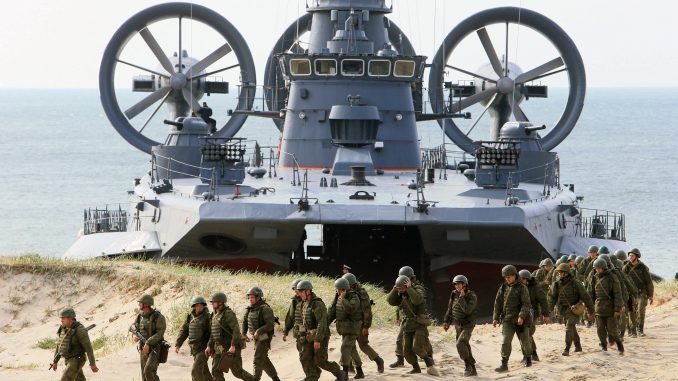
“First of all, these exercises are intended to demonstrate their power. The Russians are beginning to appear to the world and NATO as a weak link, a weak state. The Russians need to flex their muscles and show that they are strong,” says defence and armaments expert Darius Antanaitis on Žinių Radijas programme Atviras Pokalbis about the Zapad 2025 exercises currently taking place in Belarus, lrytas.lt reported.
The Zapad exercises have been held since Soviet times. During these exercises, Russian and Belarusian soldiers test plans for fighting an equal or stronger enemy in the West. The scenarios can vary; for example, the 2009 Zapad exercises simulated a nuclear attack on the Polish capital, Warsaw. During the last exercises in 2021, Zapad covered almost the entire territory of Belarus. A series of preparatory training sessions took place before the official start of the exercises.
This time, no more than 30,000 soldiers are participating in the Zapad 2025 exercises, which are significantly smaller in scale than those held in 2021. At that time, about 200,000 soldiers participated in the Zapad exercises, which were held just a few months before the start of Moscow’s invasion of Ukraine.
“This level of capacity is pitiful compared to previous exercises,” said Antanaitis.
The most likely scenario is a violation of airspace
According to him, the bigger problem is that Russia will apply the lessons learned in Ukraine during the exercises. This means that drones of questionable quality will be used. This means that there is a growing risk that unmanned aerial vehicles will stray into the airspace of a European Union member state.
Therefore, we may see deliberate or accidental provocations during the exercises.
“If a drone, missile, aircraft, or helicopter flies in, we must defend our state’s sovereignty and our citizens and neutralise this threat,” said Antanaitis.
Speaking about pre-planned provocations, he added that “you can’t get inside the Russians’ heads,” but in any case, we should look for logic in their actions.
“For example, if a provocation took place in Poland, it would be an attempt to get used to it, to show that I don’t care, you can’t do anything to me.
If there were diversions in Lithuania, what would you want to achieve? To bring even more NATO forces here? Well, okay, good for you, that’s what we want. Will they train by blocking our signals, gathering intelligence, and trying to act more realistically to see how we operate?
I think so, definitely. In 2003, when we were not yet in NATO, Russia and Belarus jammed radio signals during training exercises, and if I’m not mistaken, Russians were even caught trespassing on Lithuanian territory.
Without a doubt, the Russians will want to test us. They are training their soldiers, and what better training could there be than real-life experience?” pondered Antanaitis.
Threat to Ukraine
Arvydas Pocius, a former army commander and member of the Seimas National Security and Defence Committee (NSGK), who also participated in the program, recalled that before Lithuania joined NATO, several “lost” Russian armoured vehicles had entered Lithuanian territory during such exercises.
“I think that the Lithuanian army is now on high alert, and they are doing their job together with the State Border Guard Service (VSAT). Our allies have also arrived, and the “Thunder of Perkūnas” exercises, involving the Lithuanian army and NATO allies, are taking place in parallel.
We are making specific preparations on our part. Where I see risks, as in 2021, before the war in Ukraine began, there is a possibility that after the exercises, the Russian army may leave a disguised mobilisation in Belarus, and may leave Russian soldiers near the border with Ukraine.
Another thing, I think, is the announcement that they will test their new hypersonic missile “Orešnik” here, which can be deployed in Belarus, which is a kind of blackmail, a demonstration that, if necessary, they will launch that weapon towards the West,” said Pocius.
However, he assured that infantrymen cannot “accidentally” enter Lithuanian territory because a fence and electronic systems protect the entire border. Additionally, border guards have gained extensive experience in dealing with undocumented migrants.
“The most likely scenario is the incursion of drones and other aircraft. There may be such tests,” said Pocius, speaking about possible provocations.
He considered that Russia, under the guise of the Zapad exercises, could deal a painful blow to Ukraine by striking from Belarusian territory.
“Intelligence must do its job. I believe that sharing information with our allies would be really necessary for Ukraine,” said Pocius.
What is NATO doing?
Antanaitis noted that the Zapad exercises mainly involve conscripts, rather than soldiers hardened in battles against Ukraine.
“You have to look at it from above. The Zapad exercises are not tactical training, where the unit commander devises an idea and executes it. These are strategic-level exercises that take place between two countries, if Belarus can be called a country at all. But the goal is strategic – to demonstrate their power to the West,” said Antanaitis.
He emphasised that warfare is in a constant process of evolution. The war in Ukraine has shown that drones are the primary weapon. This means that all sides are now scrambling to neutralise the threat they pose, i.e., to defeat unmanned aerial vehicles.
“NATO is not standing still either. Of course, it does not broadcast every day what it has already done and what it is planning to do, because operational security must be maintained. And we understand that NATO is doing nothing, just lying somewhere and watching. But that is not true. Evolution is happening. Drones will remain after this war, because the robotisation of the battlefield will be even greater (…). However, at the end of the day, the footprint of the infantryman will still have to appear in the enemy’s territory. I think NATO is learning, but it’s not trumpeting it loudly, it’s just quietly and calmly preparing,” said Antanaitis.

Be the first to comment