No Picture
History

The Commonwealth Educational Commission: a new approach to teachers and education

Pope Clement XVI’s decree pronouncing the closure of the Jesuit Order reached the Lithuanian and Polish Commonwealth in 1773. Jesuits financed a number of schools in Lithuania and Poland, including the Academy of Vilnius. The state faced the tasks of making use of the huge wealth of the Order and of finding new supervisors of the schools or, in other words, of solving problems in the area of education. […]

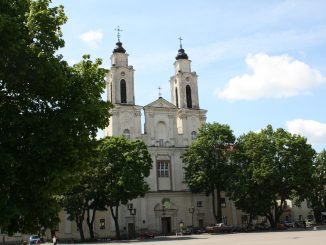
Kaunas Jesuit Church
History

Alfonso Salmerón, the First Jesuit in Vilnius

The Spaniard Alfonso Salmerón (1515–1585) was one of the closest companions of Ignatius Loyola, the founder of the Society of Jesus, and he played an active role in the affairs of the order in its early life in Paris and later in Italy. Salmerón and Loyola met at the Sorbonne in 1536, where they were studying theology. Not long afterwards, with a few other friends, they founded the Society of Jesus. […]

Cossacks
History

The Chmelnitsky Uprising and the Grand Duchy of Lithuania

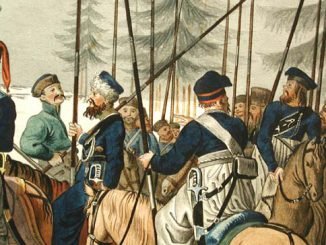
In early 1648, a Cossack uprising led by Bogdan Chmelnitsky broke out in Polish-ruled Ukraine, which the country’s leaders did little to suppress. As was usual in the first half of the 17th century, the Grand Duchy of Lithuania did not keep a standing army, only garrison units in Smolensk and Daugpilis. Whenever the threat of war loomed, it had to form a new army from scratch each time, so the private armies of the nobles were always the first to go into war, and were only later joined by conscripts. […]

No Picture
History

When the leaders of the Commonwealth and Russian Empire met in Biržai for entertainment and secret agreements

In the early 18th century, Europe was crippled by two major wars. France was preparing to go to war with Western Europe (England, the Holy Roman Empire and many German principalities) over the Spanish Succession. Meanwhile, in Eastern Europe, Russia, Denmark and Saxony agreed to attack Swedish possessions and share them out between themselves. The Republic of the Two Nations found itself in an anomalous position. […]

Monument to King Mindaugas
History

The last medieval dukedom: the coronation of Mindaugas

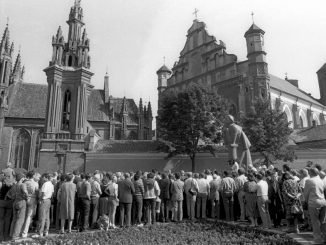
The Lithuanian dukedom was in existence for 10 years only: from the coronation of Mindaugas in July 1253 to his murder in 1263. Later two more attempts to create the Lithuanian Dukedom were known. Grand Duke of Lithuania Vytautas tried to do that at the end of his life in 1429–1430. In 1526, a new plan was born at the Council of Lords of the Grand Duchy of Lithuania to establish a separate Kingdom of Lithuania by crowning Sigismund August, the juvenile son of Sigismund the Old. Both of these attempts failed. […]

GDL Grand Duke Aleksandras and his wife Elena
History

Medieval Lithuanian princesses in foreign countries – diplomacy of men and stories of women

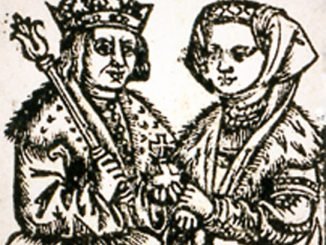
Around 1250, with the help of great military and diplomatic efforts Mindaugas managed to dissolve a union that posed a serious threat to his power. During political negotiations Mindaugas’ daughter of unknown name was engaged, and later she was married off to Švarnas, a son of Duke Daniel of Galitch-Voluin who was one of the greatest rivals to the Lithuanian King in the region. That was the first marriage of the family of the Lithuanian Rulers, which can be called interdynastic. […]

Jurbarkas
History

Reformation in Renaissance Samogitia: the family of Skaczewski

The story of Stanislaw Skaczewski (Lith. Stanislav Skaševskis) (†1579), coming from the gentry and having moved to Samogitia from Masuria in Poland (Szczytno, Zakročin) in the first half of the 16th century, and that of his family is sufficient proof that emigrants from the Polish gentry were well-adjusted to the life in GDL. Furthermore, it adds vivid details to the development of Reformation process in this region and sheds light on the influence of clientele relations in Evangelical movement. […]

Playing cards
History

Cards in Medieval Lithuania, or the earliest pop culture in Europe

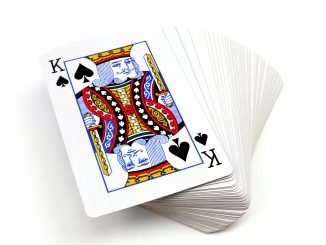
For many centuries, playing cards looked quite different from what they look now. It was not before the second half of the 17th century that the French started producing cards in manufactures by means of printing in response to the growing demand for cards. The green cards (clubs and spades) gradually turned into the black ones because the black colour was more readily available. In addition to that, the French-style pack of cards featured a queen instead of one of the jacks. […]

Coffee
History

Coffee, tea and chocolate in the Grand Duchy of Lithuania

Coffee, tea and chocolate were exotic drinks in Europe as they became popular in the 17th and 18th century reflecting the increasing integration between the Old World and other regions and Europe’s certain openness to the world as a consequence of geographic discoveries and the development of the colonial system. Chocolate was the most exquisite product followed by tea. Tea became very popular in Russia and England. It was coffee though that eventually claimed the top spot throughout Europe leaving tea and chocolate behind. Coffee was not always used in its pure form as the noblemen enjoyed genuine coffee while peasants could only afford “coffee”. […]

Potatoes
History

When did potatoes enter Lithuania?

Potatoes (lat. solanum tuberosum) represent one of the vital staples in the whole world. They serve as a key ingredient in making more than 200 food and other products. It was in the mid-19th century that potatoes spread in Lithuania on a massive scale. Very little is known, however, about how and when potatoes first entered the country. Therefore, the historical literature on the matter sometimes features certain mythologized assertions. […]

Renaissance
History

What did burghers wear in Medieval Lithuania?

Clothes, just like tableware, were a form of demonstrating the social prestige of certain individuals. In Lithuania, clothing could reveal a person’s social standing yet not always. No costume specific to city residents developed as the members of the elite followed the fashions set by the nobility. Poor city residents effectively dressed the same as peasants. […]

Kernavė
History

Haunted Graves

A grave of a 45–50 year-old woman, dating back to the 14th century, was unearthed by archaelogists in the Kernavė burial site. The woman‘s skull was turned round and laid in the chest area. The bones of her arms, severed at the elbows, were found between the legs of the deceased woman. The bodies of deceased persons whose heads were decapitated or limbs severed should be related not to burial rites but to exhumation and defiling of corpses, caused by the deceased person in person. In this particular case, archaeologists are likely to have discovered a grave of an apparition or a “vampire”. […]

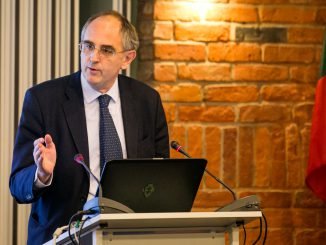
Edward Lucas
History

Unpacking the history of the Baltic “Forest Brothers”

War is never two dimensional. Edward Lucas considers one chapter of anti-Soviet resistance, on the website of the Center for European Policy Analysis. […]