
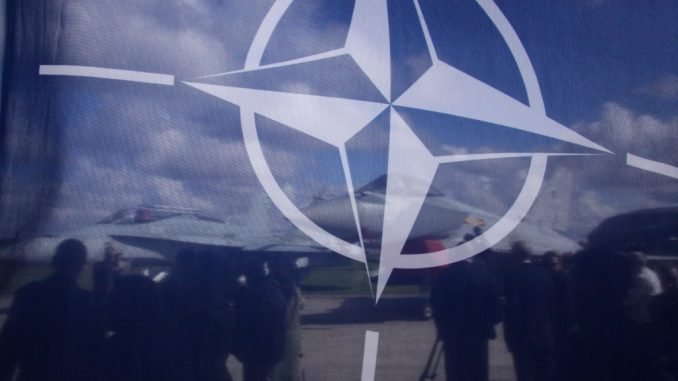
According to the American publication The Wall Street Journal, European countries bordering Russia are increasingly concerned about the Russian military’s actions. Russia is strengthening its military forces near the Finnish border, and its military experts openly admit that they are preparing for conflict with NATO, TV3.lt reported.
About the current situation, journalist Vladimiras Laučius spoke with military expert and reserve Major Darius Antanaičius on TV3’s news program Dienos Komentaras (Daily Commentary).
-Russia is rapidly strengthening its military and infrastructure near the border with Finland and Norway in Karelia. Bases are being prepared there for tens of thousands of Russian soldiers, who would become the core of the Russian army’s attack on NATO countries. Is it realistic that such an attack will occur, or is what is happening on the Finnish border preparation for it?
-There are several criteria here. First, Russia did not build up its forces on the Finnish border until Finland became a NATO member. When Finland and Sweden joined NATO, Russia openly stated it needed new divisions to deploy along the border with Finland. It should also be remembered that Russia has its nuclear arsenal on the Kola Peninsula, which is aimed at the US, and they need to defend it.
The Russians will still have to build up their potential, as they are losing a lot in Ukraine. That potential is being taken away from the Arctic region, which is why the Arctic region is currently the weakest part of Russia.
-Well, concerning Russian preparedness, Finnish intelligence reports that in 2021, the Russians were producing about 40 tanks of their main T-90 model. Now, they are producing about 300, and they are not going to the Ukrainian front but are being put into storage in preparation for the future.
-This is because all the warehouses are now empty. Before the full-scale war in Ukraine, the Russians had between 10,000 and 12,000 tanks. Of course, most of these tanks, such as T-54, T-55, and other old tanks, were obsolete. According to confirmed data, the Russians lost more than 3,800 tanks in the Ukrainian war, and those tanks are precisely the ones that, according to the Russians, are modern Russian tanks—the T-72 and T-90. According to some sources, the Russians produce many tanks, while according to other sources, the Russians produce or want to produce 30 T-90 tanks per month, but only up to 15 tanks are being made due to numerous sanctions. It is because the T-90 is not a new tank but a modernised T-72 with newer electronics, optoelectronics, and the like. And if we look at how many tanks the Russians have lost during that time and calculate that they produce 30 tanks per month, it will take the Russians 10 years to make up for their losses.
-But now they produce 300.
-This is unconfirmed data because we are counting 300 modernised tanks, those that have been taken out of long-term storage. Also, what we see from video footage from Ukraine is that the Russians have begun to use T-54 tanks, T-55 tanks, and other old tanks that have no sensors or any means of communication, and so on.
-General Christopher Cavoli, the Commander of US forces in Europe, spoke to a US Senate committee and said, “The Russian military is renewing and growing faster than most analysts predicted. The Russian army is larger today than it was at the start of the war.” So all the talk about the Russian army being weakened by the war in Ukraine was just nonsense if, as Cavoli says, it is actually getting stronger?
-If we listen to what Cavolis said, he said that it is larger. And that is natural. Because when the Russians started a full-scale war against Ukraine, they hoped to defeat Ukraine quickly. And only then did they start building up their forces. Let’s remember the partial mobilisation, the hiring of mercenaries, and that the Wagner group and other groups artificially combined to boost the Russian army. There is no doubt that if you are not successful on the battlefield, what do you do? You try to grow.
However, the numbers are general. That is, the Russian army as a whole is growing, but its capabilities are not growing because they are being destroyed, and there are many sanctions and many manpower losses. Again, if we look at tank production, it will take the Russians ten years to replace what has been lost in the last three years.
-Well, not only is the quantity improving, but so is the quality. The Russian soldiers are becoming more skilled on the battlefield, and drones, according to the Wall Street Journal, which I am referring to now, are also becoming much more modern and capable in Russia recently. But then there was the discussion between US President Donald Trump and Ukrainian President Volodymyr Zelensky in February when Zelensky said that we in Ukraine are holding back Russia, which is planning to continue attacking NATO countries. Donald Trump said, “No, I don’t think they will attack.” Who would you agree with—Zelensky or Trump—on this issue?
-I would not like to comment on either U.S President because these are their negotiating positions and their electoral positions because they have to speak to their voters.
But let’s look at December 2021, when Vladimir Putin announced his strategic plan, which is, first and foremost, to crush Ukraine to exploit Crimea and control the Black Sea and also, probably, to mobilise Ukrainians for the Russian army, then continue its march towards the West, as was said, to force NATO to withdraw from Eastern and Central Europe.
Therefore, I still believe that, given the current situation, the Russians have achieved their first goal: they have a land route to Crimea and could theoretically control the Black Sea, but they cannot mobilise Ukrainians because they have not occupied the whole of Ukraine. Ukraine has not become a union republic like Belarus, for example.
Therefore, the Russians succeeded in the first stage but could not achieve the second stage.
-But your forecast is very short-term. Is it doubtful that Russia will attack a NATO country in the next five years?
-Five to six years is a very realistic timeframe for them to be ready to do so. Whether they will attack depends solely on our ability to deter them.

Be the first to comment