
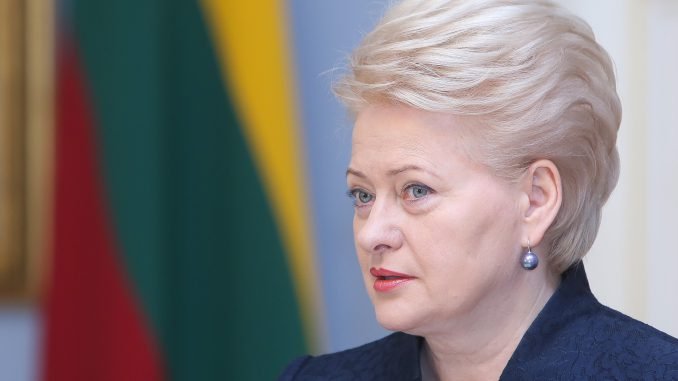
Former President Dalia Grybauskaitė spoke candidly to Polish broadcaster TVP World about the West’s years of appeasement of Russia. In the interview, Grybauskaitė recalled meetings with world leaders, rejected warnings and open ultimatums from Vladimir Putin. According to the article in lrytas, she also revealed how economic interests and illusions led Europe to the brink of full-scale war, lrytas.lt reported.
In 2009, US President Barack Obama’s policy of ‘resetting’ relations with Russia came as a real shock to the Baltic states. According to Grybauskaitė, this ‘friendship’ concealed a dangerous misunderstanding, the cost of which could have been the security interests of the Baltic states and part of Poland. Secret documents from that time even contained plans to place the region’s air defence ‘umbrella’ under Russian responsibility.
“It was difficult to speak about this publicly, but it was clear that we could not accept it,” she recalls. In response, Grybauskaitė, together with the then Polish President Lech Kaczyński, demonstratively rejected Obama’s invitation to attend a dinner in Prague.
“We said we would not be drinking champagne to celebrate agreements of this nature,” says the former president. This move instantly caused a rift with the new US administration, but six months later Washington realised its mistake and removed these issues from the agenda.
Moscow’s next weapon was far more insidious – corruption and the manipulation of the greed of the Western elite. Russia successfully employed not only fine rhetoric but also underhand methods: it funded radical opposition parties and used energy as a lever.
Grybauskaitė emphasises that it was precisely energy interests that enabled Moscow to corrupt European leaders successfully.
“We saw the ‘Schröderisation’ of Germany, and later how the French Prime Minister also succumbed to energy interests,” she says, adding that Western decisions were heavily influenced by sheer economic greed.
The former president gained a particularly clear sense of what it means to seek compromises with Moscow in 2010 in Helsinki, during her first meeting with Vladimir Putin. Lithuania, which at the time was entirely dependent on Russian gas and was paying 30–40 per cent more than Germany, was presented with an open ultimatum.
“It became clear during the discussions that this was about obedience, about capitulation,” says Grybauskaitė. Putin read out a list of demands, clearly demonstrating his attitude towards his neighbours: “Either you kneel, or you are an enemy; there is no middle ground.”
Realising that it was impossible to reach an agreement with Russia without compromising the country’s dignity, the Lithuanian leader initiated a rapid project to build a liquefied natural gas (LNG) terminal. By the end of 2014, this decision had enabled Lithuania to become the first country in Europe to break free from its dependence on Gazprom completely.
Meanwhile, the rest of Europe moved at a much slower pace. Having interacted with German Chancellor Angela Merkel for many years, Grybauskaitė saw how commercial interests paralysed the German elite. Although Merkel was aware of the threat posed by Putin, her priority was peace at any cost.
The president recalls asking Merkel directly why she travelled to Moscow so often, even though Putin openly humiliated her.
“Yes, I know, but I will go there as often as necessary to prevent war,” Grybauskaitė quotes the German Chancellor as saying. It was precisely for this reason that the Baltic states’ warnings about the Russian threat and the geopolitical danger posed by Nord Stream fell on deaf ears for a long time. The West stubbornly dismissed this as mere commercialism.
However, the political reality is different today.
“Now, when I meet even with Mrs Clinton or others, the first thing they say is: ‘Dalia, we didn’t listen to you about the threats following the occupation of Crimea, but you were right all along’,” the former president shares.
According to Grybauskaitė, the decisive turning point came at the 2014 Vilnius Summit. Although European leaders, including Angela Merkel, agreed to compensate Ukraine from the EU budget for losses resulting from Russian sanctions, then-President Viktor Yanukovych refused to sign the agreement.
“It was clear that he was frightened and personally affected, perhaps even by the threat of physical reprisals,” says Grybauskaitė.
This capitulation exhausted the Ukrainians’ patience and sparked the Maidan Revolution.
Recalling the large-scale Russian invasion that began in 2022, the former Lithuanian leader makes no secret of her astonishment at the absurdity of such a move by Moscow.
“I was astonished by Russia’s stupidity. They do not need new territories. To humiliate a nation and turn the Ukrainians into enemies for all time,” she reflects.
The war, according to the president, has not only forged a Ukrainian identity stronger than ever before, but has also turned historically close nations into enemies for centuries to come.
When asked whether Russia will ever be able to change, Grybauskaitė says she dreams of this and wishes for the Russian people to live in a democratic society, protected from the rulers who persecute them. However, she remains a realist.
“Will Russia change? I don’t know. If they are unable to change, we will be better off if there is an iron curtain between us,” she said.

Be the first to comment