
Early Sunday morning, some residents of the Varėna district woke up to an unusual sound. Air Force radar near Varėna recorded a marker moving toward the Kaliningrad region, likely a drone flying from Belarus. No air hazard was declared – it was reportedly determined that the object did not pose a threat to the public, as it was not descending but maintained a constant course, Agnė Černiauskaitė states in the lrytas.lt article.
“The data available was insufficient to determine the type of object with certainty, but its direction of movement was observed, and the other data available at the time did not indicate any immediate threat to the people or property of Lithuania. As it had clearly left Lithuanian airspace, there were no grounds for issuing an air raid warning,” explained a statement from the armed forces issued later.
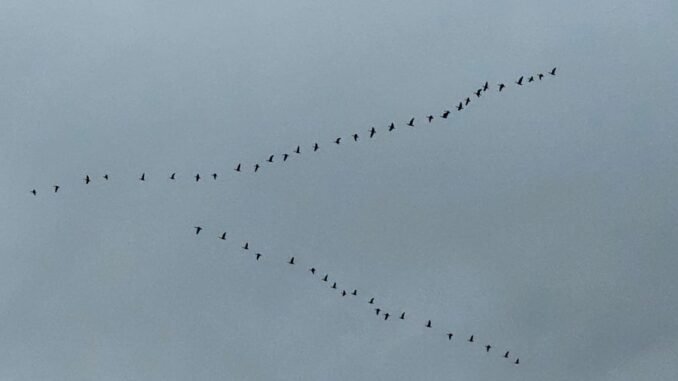
Later that same day, after midday, residents in Vilnius and the surrounding areas received alerts regarding an air threat classified as ‘Yellow’. This means that an attack is likely but has not yet taken place. The Lithuanian Armed Forces urged people to seek cover or take shelter in secure, enclosed premises. Vilnius Airport was closed. Fighter jets from the NATO air defence mission were scrambled. They soon established that it was merely a flock of birds.
Even more interestingly, radar detected the first object at 04:05, and it left Lithuanian territory at 04:25. Residents of the Varėna district had already begun sharing sounds and sights of a possible unmanned aircraft flying past their homes much earlier.
“At 03:17, it was flying over Eišiškės towards Varėna”, “At 03:29, it was heard in Salovartė”, “I heard it – at exactly 03:29,” – people themselves posted in Varėna district groups, and some even attached video clips to these messages as evidence, in which the sound of the passing object can be clearly heard.
Vilmantas Vitkauskas, Head of the National Crisis Management Centre (NKVC), stated on Monday that it is still unclear whether it was a drone. He noted that the country’s authorities are assessing whether the incident was a provocation or a test of Lithuania’s response systems.
According to the head of the NCM, the authorities are also currently assessing how neighbouring Belarus and Russia reacted to the incident.
“In fact, there was virtually no reaction. So, one can also make a certain assumption that this was most likely not a stray Ukrainian drone, as this would have been reported and discussed – that such a drone had entered and flown through Belarusian territory,” said Vitkauskas.
Defence Minister Robertas Kaunas said on Monday that he was not satisfied with the information the authorities provided about the drone that may have violated Lithuanian airspace on Sunday. He requested that a working group of experts be set up to clarify the exact circumstances of the incident. He pointed out that all Lithuanian residents must be kept equally informed about such incidents.
“I believe it is certainly necessary to be able to identify birds and distinguish them from drones or other flying objects. This is where the army’s efforts are needed, and, of course, additional solutions that are being implemented,” said Kaunas on Sunday.
Kumpis: it would be laughable if it weren’t so sad
What do these two incidents say about our airspace surveillance and defence system? Security expert Arūnas Kumpis is blunt: in his view, it is obvious the system isn’t working
According to him, official reports suggest the drone was flying over Lithuanian territory at nearly 300 km/h, passing through one of NATO’s most sensitive defence areas – the Suwałki Corridor. However, based solely on reports from members of the public – which the expert himself has seen – it is clear that they spotted the object once again well before our radars detected it.
“It doesn’t necessarily mean that the timings quoted by the military are accurate. It simply means those are the times when they detected the object. Detection and entry into airspace are two different things,” Kumpis told Lrytas.
He finds it hard to understand the excuse that an air threat was not declared at first because the object was allegedly maintaining a steady course. Kumpis is convinced that residents should have received alerts on their phones at that moment.
Unlike the second instance, which, according to the expert, is downright bizarre, fighter jets costing millions are deployed to identify the object visually.
“It is obvious that the risk to residents was in the first scenario, not the second. But since the system isn’t working, we’re resorting to the most basic form of fortune-telling: coffee grounds. Officials are only looking out for themselves. It turns into a lottery – what can you do? You won’t always get it right by guessing – you might win, you might lose. All that’s left is to make excuses, as in the second scenario, that it’s better to be over-cautious than not cautious enough.
In the first scenario, we weren’t cautious enough, and then we have to explain that, based on all the evidence, we thought there was no threat:
“Imagine drones flying over NATO’s most vulnerable defence zone, the Suwalki Corridor, and we decide that this poses no threat to us,” remarked Kumpis.
The security expert emphasises that it cannot be any other way when our airspace surveillance system cannot reliably identify an object flying in the air based on the sound it emits, its altitude, speed, and other parameters.
“There are several long- and medium-range radars deployed across Lithuanian territory. They monitor objects in the air at great distances. However, medium- and long-range radars have a limitation: while they can monitor objects at long distances, up to 400 km, they struggle with low-flying objects. Because of basic physics, Earth’s curvature, and the fact that low-flying objects are obscured by mountains and trees, long- and medium-range radars cannot detect them. They either detect them or they do not.
That is where short-range radars come in. However, they must be spaced 50–70 km apart. We have a few of these radars, and we have ordered more, but not enough to cover the entire border. In addition, various sensors are required, positioned close to the border as well as further inland. For example, acoustic sensors detect sound and can determine whether an object is an aircraft, a missile, or a drone, and even identify the drone’s specific model.
Once a network of sensors and short-range radars has been deployed, data flows in real time into a centralised system, which selects the appropriate means to neutralise the target. We do not have any of this, so we are left guessing what is flying there,” explained Kumpis.
He pointed out that the Latvians have already deployed a network of acoustic sensors and short-range radars along their border with Russia, not to mention the Ukrainians, who, based on the sound, size, flight altitude, direction and speed of the object crossing the border, can accurately determine whether it is an aircraft, a missile or a drone.
The expert claims that such sensors were discussed back when Laurynas Kasčiūnas was head of the Ministry of National Defence, but we still do not have them. According to Kumpis, the problem is that the responsible authorities are stuck in their ways, guided by procurement plans that no longer reflect today’s realities, whilst the minister, juggling his words, evades giving straight answers.
“It’s a curious sight. It would be laughable if it weren’t so sad,” stated Kumpis.
Back in the spring, after the first drone incidents, Defence Minister Kaunas emphasised that, to identify low-flying objects in the future accurately, Lithuania must develop an air defence ecosystem, a key part of which is acoustic sensors and a corresponding database.
According to him, Ukraine has such a database, and discussions are underway regarding access to it and its regular updating.
Čmilytė-Nielsen: We will invite the minister to the NSGK
Viktorija Čmilytė-Nielsen, leader of the Liberal Movement, has questions regarding our algorithms for alerting the public, as it appears that the situation is assessed differently in each case.
She would like to hear the answer from the Minister of National Defence, Kaunas, himself, whom she will invite to appear before the Seimas Committee on National Security and Defence (NSGK).
“The NSGK and the minister will clarify the situation, how these algorithms work, and why in some cases the decision is made to send alerts, whilst in others it is not. It is in all our interests that, when people receive these messages, they take them very seriously and act accordingly – so that there are no false alarms and, conversely, no lack of response when the danger becomes real. I’m not saying that was the case this time; perhaps there were serious and compelling reasons, but we simply don’t know them fully,” Čmilytė-Nielsen told Lrytas.
The Liberals invited the minister to a meeting with their parliamentary group last Thursday. They asked what had changed in the nearly six months since the first time a drone flew into our territory and an air threat was declared for the first time.
“The minister spoke mainly about contracts, planned acquisitions and other matters. He said less about the very down-to-earth, concrete capabilities we already possess. Preparations are underway, but our capabilities have not increased. This is a cause for concern. Everything is moving far too slowly,” the politician remarked.
The Liberals also questioned the minister about expanding the radar system and acoustic sensors.
“The minister has repeatedly stated that efforts are being made to acquire some items, whilst contracts have been signed for others. Again, it is not the case that everything is easy to procure, but things are moving rather slowly.
We are facing yet another problem, which is very serious in Lithuania; I do not know what the situation is like in Latvia and Estonia, but one of our biggest problems is that the Defence Resources Agency is severely understaffed; there is a shortage of personnel, the scale of funding is enormous, and they cannot cope with it.
As the year draws to a close, we are hearing echoes of this; even the National Audit Office has noted that funds are being spent haphazardly, and as the financial year nears its end, a race against time begins to spend the money. With proper planning, this shouldn’t be the case,” criticised Čmilytė-Nielsen.
Among other things, the minister of national defence still has no deputy minister responsible for procurement.
“The minister says that he is personally overseeing this matter. He is acting not only as minister but also as deputy minister for procurement. That is too much,” the Liberal is convinced.
Although she understands that Kaunas cannot speed up certain processes, the politician also sees that he bears responsibility himself.
“A politician who holds a key position always bears political responsibility. Here, I see one problem: the frequent changes in Social Democratic governments lead to a great deal of political instability. This minister has been in post for less than a year; it is clear the political team has not yet taken shape, and it remains incomplete, particularly on military procurement.
Yes, I recognise that this falls within the minister’s remit. I understand and accept that some issues are difficult to resolve even with the best-assembled teams and the most effective managers, but on management and the efficient use of funds, Lithuania and the Ministry of National Defence are lagging. The minister himself acknowledges this. Is this his responsibility? Without a doubt,” she concluded.
Kasčiūnas: it’s hard to use a lack of time as an excuse here
According to Kasčiūnas, former Minister of National Defence and leader of the Conservatives, Sunday’s events once again demonstrated the complexity of the situation and the limitations of our capabilities.
“It is clear that we need new radar and sensor capabilities, anti-drone and electronic warfare capabilities, and a stronger, multi-layered air defence. Strengthening air defence is a long-term process, but the current security environment demands that it be implemented much more rapidly. And it is difficult to use a lack of time as an excuse here,” he asserted.
Kasčiūnas emphasised that enough time has passed since the start of full-scale war in Ukraine for at least the most critical airspace surveillance and counter-drone capabilities to have been strengthened.
“However, instead of devoting all the necessary attention to these urgent needs, a considerable amount of time and political energy has been wasted on discussions about expensive military transport aircraft and other long-term procurements. One may debate whether Lithuania will need such capabilities in the future. Still, the order of priorities must be clear: first and foremost, we must be able to monitor and defend our airspace.
Above all, we must detect flying objects in good time and identify them accurately so we can neutralise them if necessary. To do this, it is essential to have a reliable view of what is happening in our airspace and to be able to distinguish as quickly as possible between a real threat and a false alarm (at the very least, between a flock of birds and a drone),” stated the Conservative leader.
According to the former minister of national defence, the current leadership of the ministry should provide a very clear answer not only to the question of how much longer it will take to deploy these capabilities, but also as to why more has not been done in the time already available, as incidents in our airspace may increase.
“We cannot rule out further escalation across the region – to put it simply, a situation where drone incidents in the airspace of the Baltic states and other neighbouring countries would become not the exception, but the norm. That is why we need a concrete answer today: how much more time will it take before Lithuania can finally, at the very least, reliably monitor its airspace and accurately identify what is flying within it?” he asked.

Be the first to comment